|

March 4, 2005
Dear Coalition Friends:
Due to computer problems, we were unable to notify you about our presentation yesterday, Thursday, March 3rd, before the National Capital Planning Commission (NCPC) -- the federal government's planning agency for the Washington area.
The NCPC invited us to show the full Commission our PowerPoint presentation on The Future of The National Mall. This is the presentation that sparked great enthusiasm at the U.S. Commission of Fine Arts (CFA) in February. Reporter Elizabeth Wiener captured our main points as well as the urgency of the CFA's response, as well as their concerns about security barriers at the Lincoln Memorial, in her article in The Northwest Current (see the full article below).
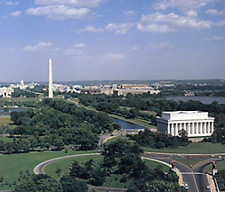
NCPC Chairman John Cogbill graciously welcomed us and emphasized the importance of public involvement and participation in looking at Mall issues. Commissioners seemed interested and supportive of our proposals for: 1. enhancing the existing National Mall and, 2. expanding the Mall so it can grow with our evolving democracy (as it did 100 years ago when the McMillan Plan expanded on the L'Enfant Mall of 1791). We call this proposed expanded Mall "The Third Century Mall."
There were some challenges and questions. The National Park Service representative, voicing his belief that NCPC's 1997 Legacy Plan ( http://www.ncpc.gov ) is adequate for the future, stated his opposition to an expansion of the Mall. (At the CFA meeting, as Elizabeth Wiener reports, he had called our work "very impressive. We agree with most of it.")
In an unusual break with tradition, Chairman Cogbill permitted us to participate in a question and answer discussion with Commissioners. This gave us an opportunity to explain our year-long work, public consultations, meetings with Congressional staff and other government agency representatives, and the evolution of our ideas as we attempt to respond to the different perspectives.
A happy coincidence was that our presentation followed a report by NCPC staff on plans for recovering and enhancing South Capitol Street and making it into a beautiful, lively Gateway Boulevard to the Anacostia River. We include South Capitol Street in our proposed Third Century Mall. Our concepts and NCPC's seem to work very well together and could reinforce one another. You can learn more about NCPC's concept from their press release by clicking here.
We'll be providing more information, and diagrams, of the Third Century Mall concept in coming days and weeks.
Please read about the important Commission of Fine Arts meeting:
THE NORTHWEST CURRENT
WEDNESDAY, MARCH 2, 2005
Federal Board to Look at Mall's Future
By ELIZABETH WIENER
Current Staff Writer
The chair of the federal Commission of Fine Arts has pledged a special meeting on the future of the National Mall, including proposals for expanded boundaries to relieve pressure to build more museums and memorials on green space.
"This is the heart of the city, the center of our concerns," said chair David Childs, promising a daylong session for the commission, National Park Service, National Capital Planning Commission, Smithsonian Institution, security officials and public groups to take a long-term look. "Let's dedicate a day to this. This is an important moment for the Mall," he said.
Childs' comments at the commission's Feb. 17 meeting followed an unusual presentation by Judy Scott Feldman, whose National Coalition To Save Our Mall has been fighting to preserve the area from overbuilding and the kind of security measures - generally seen as hasty and unattractive - that have proliferated since Sept. 11, 2001.
Her group recently launched the "Third Century Initiative" to plan for the Mall's future. Interim goals include a moratorium on new construction and security barriers and the reopening of closed parking lots at the Washington Monument and Jefferson Memorial. "It's time to step back and look at the big picture," she said.
Ironically, Feldman's presentation was followed by another Fine Arts Commission review of plans for bollards encircling the Lincoln Memorial. This time around, commissioners seemed skeptical of claims that an armored car could mount the steps from the Reflecting Pool to the Memorial, and they postponed action on a proposal for bollards on the Lincoln's east front.
Feldman, in her presentation, briefly outlined the development of the Mall since Pierre L'Enfant created "the people's space" two centuries ago. In 1901, the McMillan Commission reaffirmed that vision and then expanded the Mall west and south into marshland and riverfront to create space for the Lincoln Memorial and Jefferson Memorial.
One hundred years later, it's time for a pause and new look, she said.
Feldman showed slides of the Mall now, with views of monuments blocked by temporary fences, bollards and construction trenches. And despite a moratorium on new construction imposed by Congress in 2003, there is pressure to add more monuments, museums and related buildings - like the African-American Museum and an underground visitors center for the Vietnam Memorial - along with increasing demands for more security, she said.
The Third Century Initiative is tentatively exploring ways to keep the dwindling green space open by expanding the Mall itself, just as the McMillan Commission did in the early 1900s, Feldman said.
One proposal sketched out by Kent Cooper, the architect of record for the Vietnam and Korean War memorials, would include Hains Point and the Northern Virginia shoreline, both already in federal hands, as well as the South Capitol Street corridor, which the city wants to revitalize. Pedestrian bridges would connect the segments.
Instead of telling would-be memorial builders to look "'off the Mall,' we expand the Mall," said Feldman. "People are amazed. Their eyes just open."
The interim step, to "stop new construction and reinstate parking lots recently closed by National Park Service, until we have a vision for the future," is one of the group's more controversial proposals.
Childs, a nationally known architect who cited his 1976 work on Bicentennial plans for the Mall, seemed impressed with Feldman's presentation. "Everything you said is well-founded," he told her.
John Parsons, a deputy regional director for the National Park Service, said the Park Service is about to undertake its own major planning effort, largely dealing with the sustainability and conservation of the Mall's green spaces. But he, too, called Feldman's presentation "very impressive. We agree with most of it," he told the commission.
Commission member Elyn Zimmerman said the Mall is beginning to "look like an armed camp" and suggested that security experts be included in the long-term planning.
The commission turned its attention to the much-reviewed and controversial plan for beefing up security around the Lincoln Memorial. Federal planners have already approved a new wall around most of the memorial, and it is now under construction along with improvements to the surrounding roadways.
The plan for a line of bollards along the broad steps that lead to the Reflecting Pool has caused unease. In previous reviews, commissioners objected to a variety of designs, wondering what sort of attack could rise from the placid pool.
At the Feb. 17 meeting, architect Ron Kessler came back with a modified plan to punctuate the bollards with a low wall of light-gray stone he said would be "more sympathetic to the monument" and also provide seating for visitors. He offered two schemes, one rectangular and one with curved edges, for the monument's east front.
Neither one flew.
"Bollards in front of the monument? Can a car come up the steps?" asked commissioner Earl "Rusty" Powell, who is also director of the National Gallery of Art.
"We asked that before," said Childs. "They did say a Humvee could go up the steps." He suggested the bollards be retractable and used only on days of "red-high alert."
"I'm not sure our security people would allow that," Parsons replied. A Park Service security expert said risers on the broad, ceremonial steps are only 4 inches high and that "you could get a vehicle up those steps." Kessler, the architect, said an attack could come from the woods near the Vietnam Memorial and up the steps.
But commissioners still were resistant.
"Is there any way you could ameliorate that dreadful security line" across the steps, asked commissioner Barbaralee Diamonstein-Spielvogel.
"This is the biggest intrusion," said commissioner Witold Rybczynski. "Our children will blame us for this."
The commission postponed a vote on the various designs for the bollards, instead scheduling a site visit to the Lincoln Memorial for March 16 to view mock-ups.
|