|

THE 3RD CENTURY MALL
- "during the century that has elapsed…, the great space known as the Mall … has been diverted from its original purpose and cut into fragments … thus invading what was a single composition… The demand for new public buildings and memorials has reached an acute stage, there has been hesitation and embarrassment in locating them because of the uncertainty in securing appropriate sites…The Commission were thus brought face to face with the problem of…formulating definite principles for the placing of those future structures."
- Report of the Park Commission to the Senate Committee on the District of Columbia, 1902
The National Mall throughout its history has expanded and evolved, and it can expand again to meet civic and cultural needs of the 21st century. The recent moratorium on new memorials and visitor centers gives us breathing space to consider how and where such an expansion could happen.
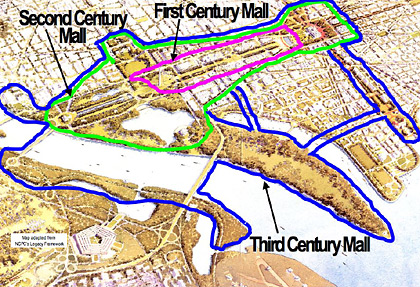
The enlargement of the Mall beyond the 1901-1902 McMillan boundaries would meet the practical need for future nationally significant memorials and museums to be located "on the Mall." History does not stand still, nor should the Mall. It would allow for enhanced public spaces for civic gatherings and celebrations. And it would provide an opportunity, in the tradition of the 100-year cycles of visionary planning for the Nation’s Capital, to re-envision the National Mall’s symbolic role as cultural and civic expression of the nation and of American democracy.
Since 2004, the professionals who comprise the National Mall 3rd Century Initiative have been considering how to create a seamless expansion of the Mall. The enlargement, we believe, does not need to be rigidly linear as was the McMillan Plan. Instead, it could encompass a three-mile-long waterfront park—for the most part, land identified by the NCPC, the National Park Service, and Congress for future memorials and museums.
With new memorials or museums positioned strategically along vistas and routes, the symbolic meaning of the Mall could grow, as it did 100 years ago. Ceremonial avenues and bridges could connect seemingly disparate areas and relieve "dead-ends" at the Lincoln Memorial, Jefferson Memorial, and South Capitol Street. New circulation patterns could unfold along the Potomac route, starting at the Lincoln Memorial at the west and punctuated by the FDR, Jefferson, and memorials yet to come, before crossing the Washington Channel and ascending Capitol Hill along the majestic new Gateway Boulevard.
We invite your support for this vision of an enhanced and evolving Mall, which embodies the National Capital Planning Commission’s Legacy Framework concepts for the Capital City, while making the National Mall—the symbolic heart of the city and the nation—a catalyst for its realization.
|